DIY Dog Brain Games
7 DIY Brain Games for Dogs You Can Set Up in 10 Minutes
Disclosure: This article contains affiliate links. If you buy through them, I may earn a commission at no extra cost to you. All seven games below are free. Learn more.
A walk exercises your dog's legs; a good game exercises their nose and brain. Sniffing, searching and solving simple puzzles are natural dog behaviors, and many owners find that a short game session leaves their dog more settled than a longer walk alone. Best of all, you can build every game below from things already in your kitchen or recycling bin.
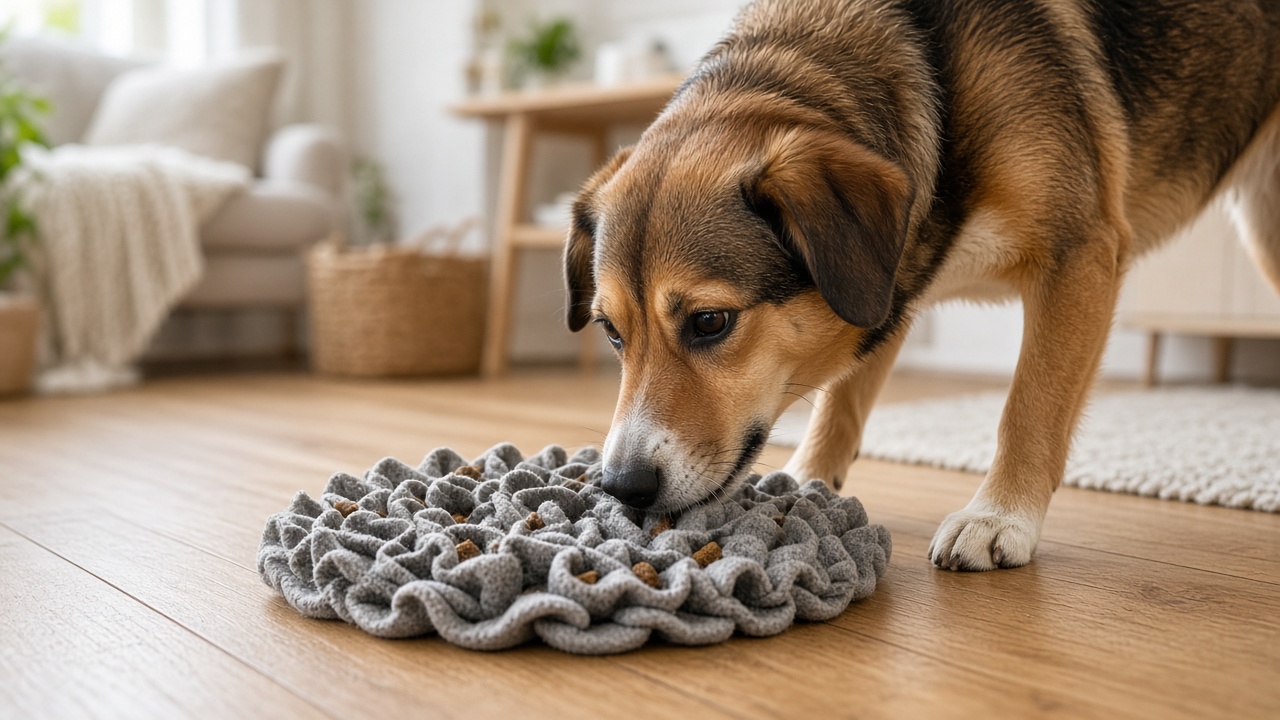
Before you start: 4 ground rules
- Use part of today's food. Measure out some of your dog's regular kibble for games, or use tiny pieces of treats, and count them as part of the day's food.
- Make it easy first. The goal of the first round is a win in a few seconds. Increase difficulty only when your dog succeeds quickly and happily.
- Supervise. Paper, cardboard and fabric are for searching, not swallowing. Pick up materials when the game ends.
- Keep sessions short. Five to ten minutes is plenty. End while your dog is still keen to play.
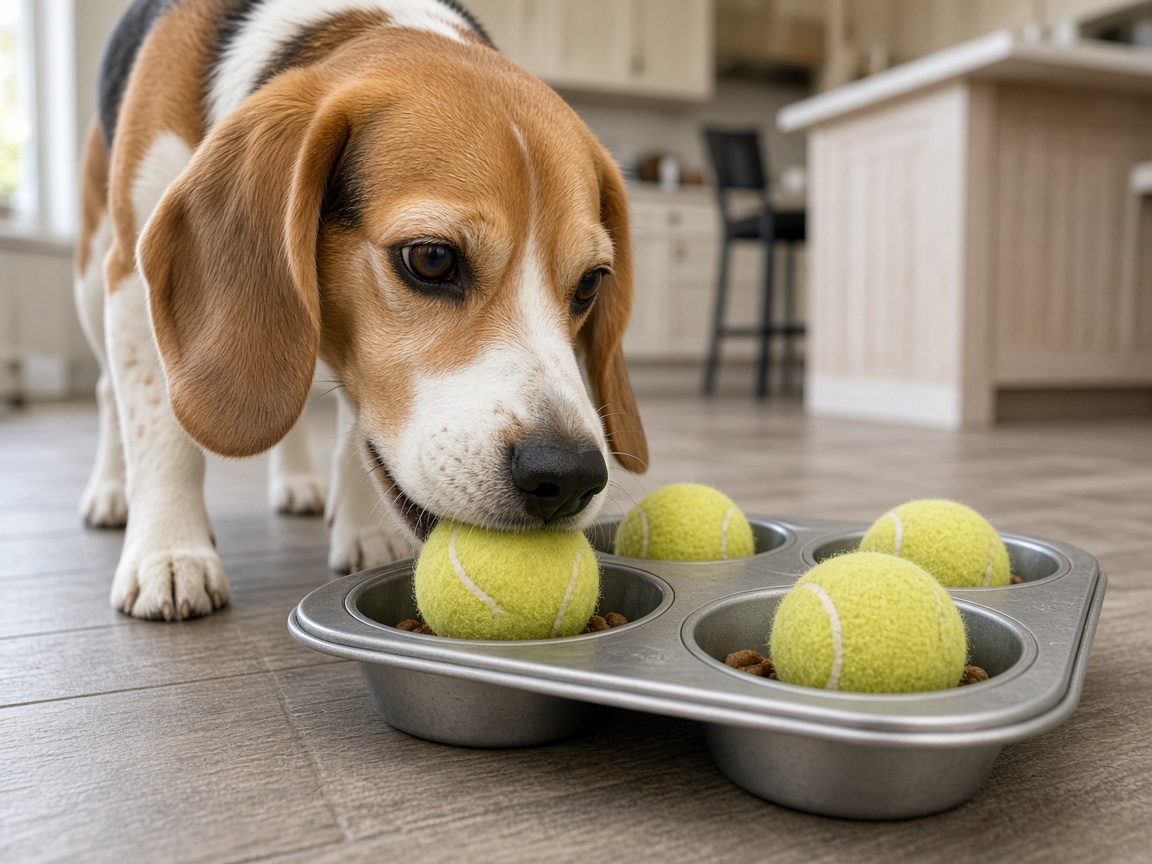
1. Muffin tin puzzle
- Drop a treat or two into a few of the cups while your dog watches.
- Set the tin on the floor and let your dog eat them — round one is just "this tin has food."
- Next round, put treats in some cups and cover every cup with a ball. Your dog has to nose or paw the balls out of the way.
- Make it harder by only baiting a few cups, so your dog has to sniff to find the right ones.
A tin with 6 or 12 cups both work. If your dog tries to chew the balls, swap them for larger ones or upside-down plastic bowls.
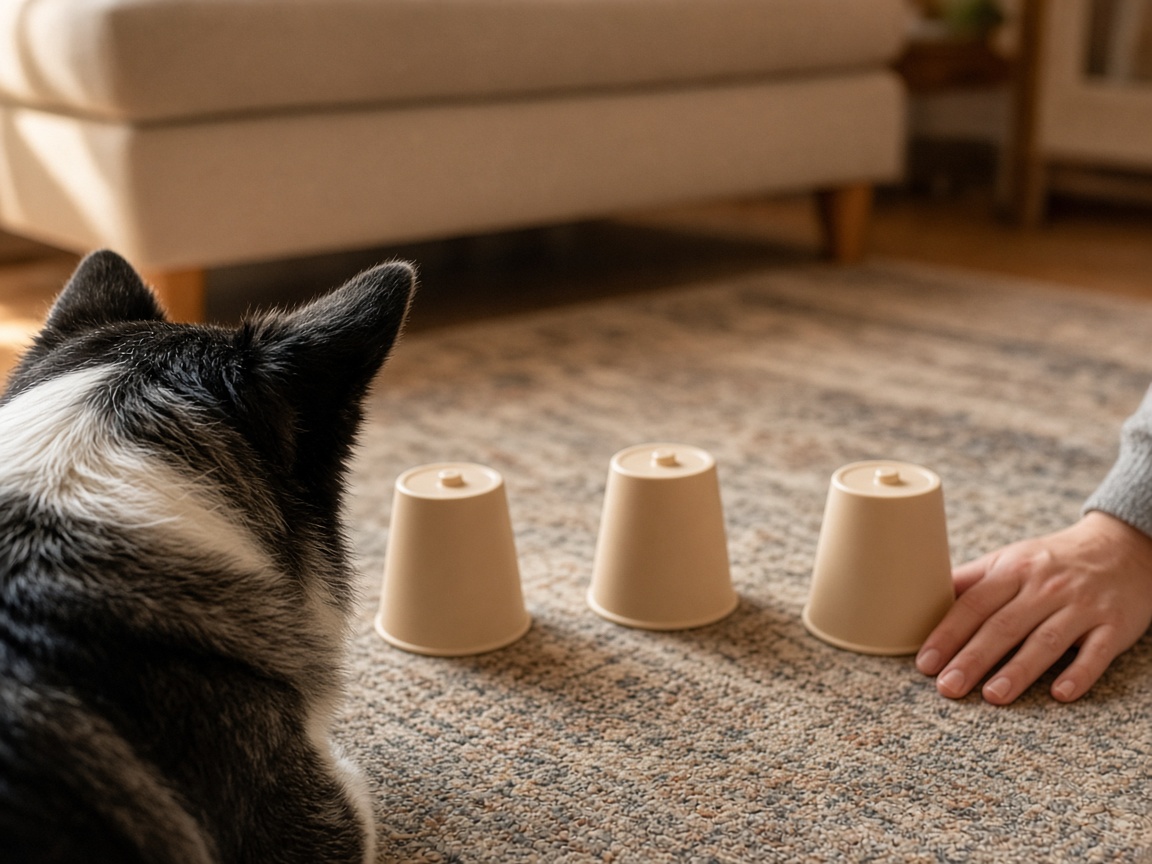
2. The cup (shell) game
- Start with one cup. Put a treat under it while your dog watches, then say "find it." Reward any nose touch by lifting the cup.
- Add a second, empty cup. Hide the treat under one and let your dog choose. Lift only the right cup when they indicate it.
- Move to three cups, then slowly start sliding the cups around before you let your dog choose.
If your dog guesses wrong, simply lift the empty cup, show the treat under the right one, and try again with an easier setup. No scolding — guessing is part of learning.
3. Towel burrito
- Lay the towel flat and scatter kibble across it.
- Roll it up loosely from one short end, like a burrito.
- For a harder version, fold the towel in half first, scatter food, roll it up, then tie the roll in a loose knot.
Dogs unroll it with their nose and paws. It is great for dogs who are new to puzzles because the food is easy to smell.
4. DIY snuffle mat
- Cut fleece into strips roughly 1" wide and 6–8" long. Fleece does not fray, so there is no sewing.
- Push each strip down through one hole and back up through the neighboring hole, then tie a single knot so both ends stand up.
- Fill every hole densely — a thick mat is more fun and harder to empty.
- Sprinkle kibble over the mat and ruffle the strips so it falls in between them.
A snuffle mat is a nice way to serve part of a meal. Supervise the first few sessions in case your dog tries to chew the fleece, and wash it regularly.
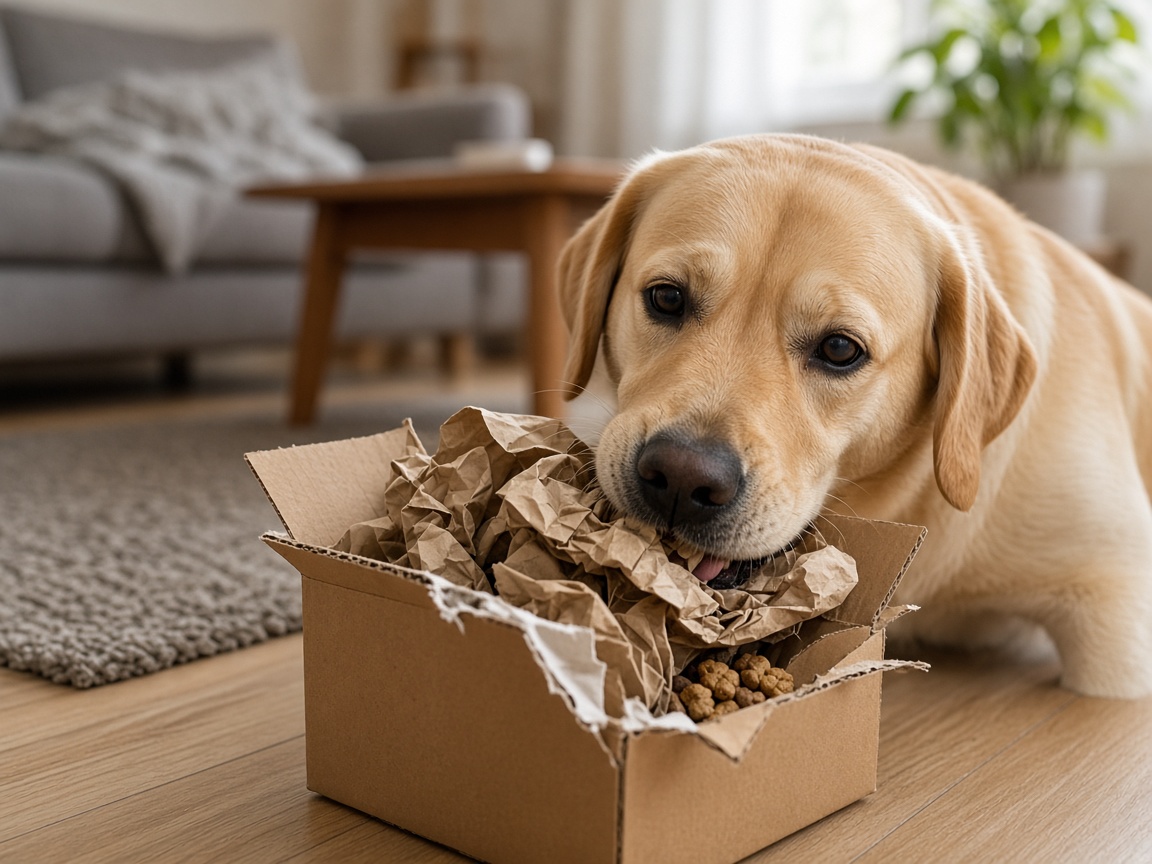
5. Box "unboxing"
- Put treats in the bottom of a small box and loosely crumple plain paper on top.
- Fold the flaps in but do not seal them.
- For more challenge, put a smaller box inside a bigger one, or tuck treats inside folded toilet-paper tubes in the box.
Most dogs love the tearing part. Remove staples, tape and glossy printed paper first, and clean up the shreds afterward so nothing gets eaten.
6. "Find it" scent search
- Ask your dog to sit or have someone hold them gently. Toss a treat a few feet away while they watch and say "find it!"
- Repeat several times, then start placing treats where your dog cannot see them land — behind a chair leg, beside a door.
- Gradually hide treats in other rooms, at different heights, and finally outside in the yard.
This is the game with the most room to grow. Some people eventually move from treats to hiding a favorite toy, then on to a specific scent, which is the starting point of the hobby called scent work.
If your dog loves these games and you want a structured, step-by-step program with more of them, there are online courses built around this idea. Below is one many dog owners look at.
Look at Brain Training for Dogs → (affiliate link)
7. Which hand?
- Show your dog a treat, then close it in one fist. Hold both fists out at your dog's nose height.
- Wait. When your dog sniffs or paws the correct hand, open it and let them eat the treat.
- If they choose the empty hand, open it to show it is empty, then try again.
It is a perfect game for a few minutes in a waiting room, on a rainy evening, or when you are watching TV.
How to make the games harder over time
- Fewer treats, more searching: bait only some of the cups, holes or boxes.
- Combine games: hide a towel burrito inside a box, or put the muffin tin in another room for "find it."
- Add duration: ask for a short "wait" before saying "find it."
- Rotate: use different games on different days so they stay new and interesting.
A note on behavior problems
Games are a fun way to spend time together and to give your dog something to do, but they are not a substitute for professional help. If your dog shows aggression, severe fear, or sudden changes in behavior, talk to your veterinarian first and consider working with a certified professional dog trainer or a veterinary behaviorist.
Want a structured program with more brain games?
Brain Training for Dogs (braintraining4dogs.com, sold through ClickBank) is an online dog training course built around games and force-free exercises.
According to the vendor, it was created by Adrienne Farricelli, who describes herself as a CPDT-KA certified dog trainer, includes 21 games plus obedience lessons with videos, and is covered by a 60-day money-back guarantee. Those are the vendor's claims; results depend on the dog and on practice, and no course replaces a vet or in-person professional when there is a serious problem.
Pros
- Structured progression instead of random games
- Force-free, reward-based approach per the vendor
- 60-day refund window as advertised by the seller
Caveats
- Online only — you do the training yourself
- Order pages may show upsells — you can decline them
- Not a fix for medical issues or serious aggression
Affiliate link — I may earn a commission at no extra cost to you.
Disclosure & Privacy
This page contains affiliate links. If you buy through them I may earn a commission at no extra cost to you. Descriptions of Brain Training for Dogs repeat claims published on the vendor's own website. This article is general information, not veterinary advice. SeeDIY (@peretzdigital) is an independent publisher and is not affiliated with the vendor beyond the ClickBank affiliate program. Full details: Affiliate Disclosure, Privacy Policy, Cookie Policy, Terms of Use.
We do not sell your personal information. Hosting, DNS, and security run through Cloudflare Pages and Cloudflare. Questions: peretzdigital@gmail.com